
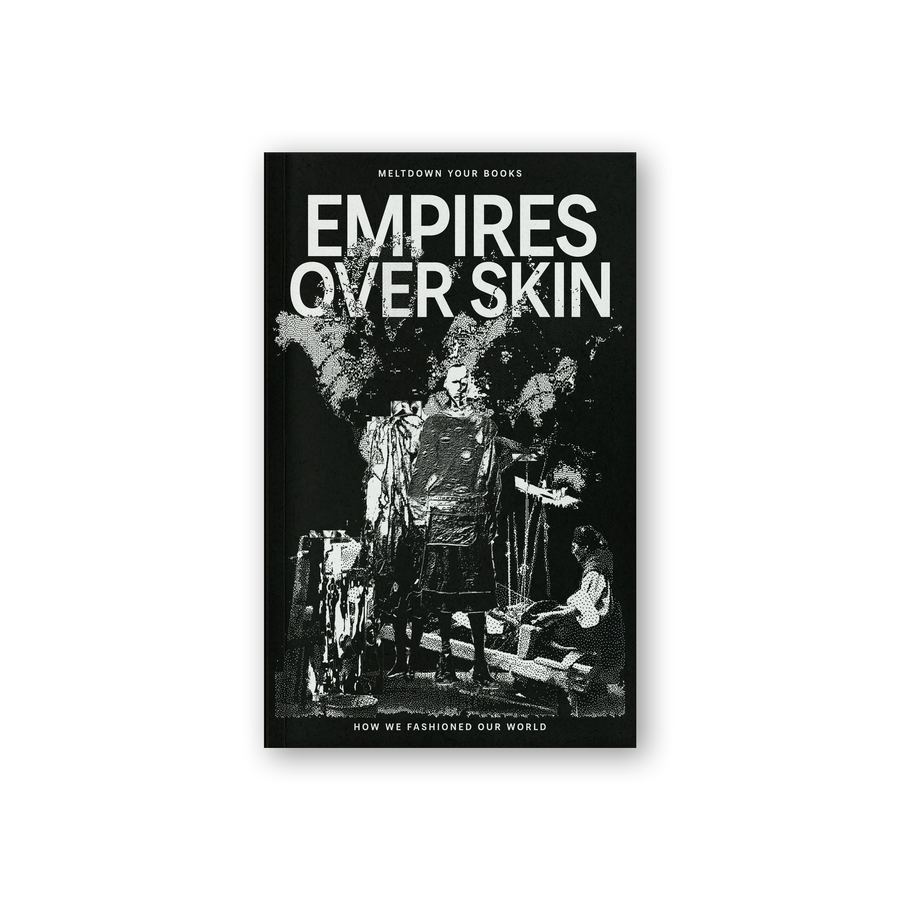
Empires Over Skin: How we Fashioned our World
Empires Over Skin: How we Fashioned our World
Meltdown Your Books
Editor: Nicholas E. Powers
Illustrator: Rachel Lilim
Layouts & Design: Becoming
(Claire Elise &
Polymnia)
Edition: 1st
Date: November 2025
ISBN: 978-9925-8207-4-0
Language: English
Dimensions: 10.5cm x 16.8cm
Pages: 298
To be human is to wake up, every morning, and to don the costume that completes your identity, for better or worse, by choice or by coercion. The task this book undertakes requires a particular kind of author, one who can recognise and sort through the contradictions on a theoretical level, but also someone who does not abstract the topic from their position as a subject—a critical book of fashion must be written by someone who lives it, someone who is passionate enough to write in good faith, because fashion isn’t just Gucci and Sweatshops—which themselves are rightly condemned for all kinds of reasons—because fashion itself is merely the tip of what may be one of the biggest, deepest ice bergs of all—Fashion is a philosophical black hole, one which drags everything into its infinite stomach, from semiotics to psychoanalysis, to art, design and craftsmanship, to economics and production chains, to speculation and historicising, to algebra, journalism and so on.
Yet, this isn’t a philosophy book, because it is too down-to-earth and relatable; the book is just as celebratory and excited as it is critical. M.Y.B. begins by simply looking down, and beginning to describe the shoes upon their feet—it unravels dialectically and uncovers long chains of connections that stretch back through time.
About the author:
"Meltdown Your Books (M.Y.B.), the pen name, was made as a portmanteau of the seminal essay Meltdown by Nick Land, and the landmark film Throw Away Your Books, Rally in the Streets by Shuji Terayama. I chose the name, almost 3 years ago now, to reflect the political and digital black hole I saw hovering at the edge of contemporary media experience, and to present my work without the muddy veneer of personal identity. It has remained, since its inception, an anonymous project in only the loosest terms. The dedicated could always find my real identity, and some have, and so its anonymous character existed primarily as an element of presentation. Its anonymity existed to emphasize its deindividuated character. The things I discuss and emphasize under the M.Y.B. label are not items with definitive characteristics, they are collective experiences. M.Y.B. is something I cherish beyond self."
| Tags |
|---|